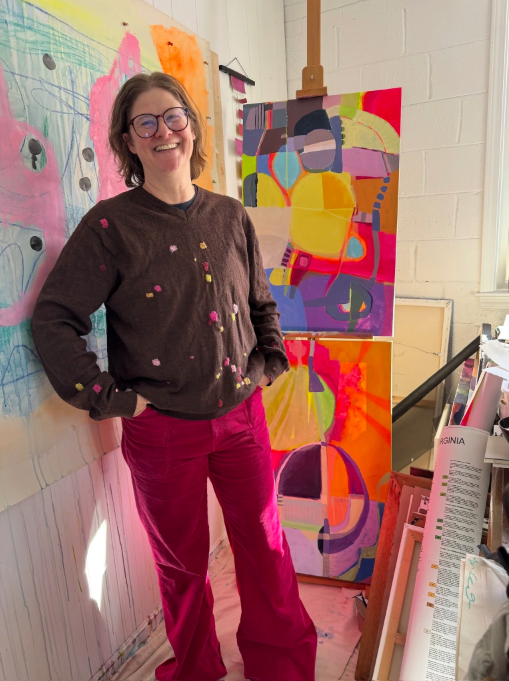
There’s a moment in every great creative conversation where you realize the “why” behind the work is just as compelling as the work itself. That’s exactly what happened when I sat down with local mixed media artist Molly McCracken.
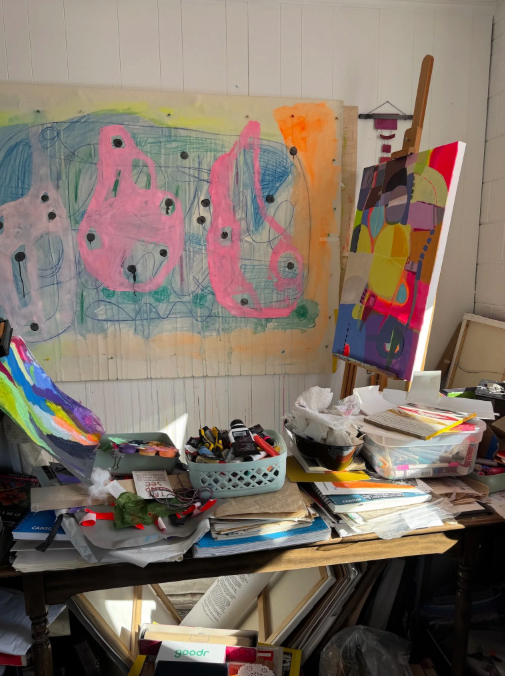
Molly’s art is tactile, color-driven, and deeply intuitive. She creates mixed media collages and assemblage pieces that feel both playful and powerful, often made from repurposed materials with a story already embedded in them. Her practice is rooted in curiosity, community, and a need to turn big feelings into something you can hold in your hands.
Below is our interview, edited into a narrative format so you can really hear her voice.
From childhood collage to creative compulsion
When I asked Molly what first inspired her to begin making art, she didn’t hesitate.
She described creativity as something she has always felt compelled to do, almost like something that needs to move through her. She also shared something many of us can relate to: art as a way to manage anxiety. Making, for her, becomes a release valve. A way to place feelings somewhere outside her mind and heart, onto paper, texture, and color.
Molly’s earliest art memory is wonderfully specific. Her mom still has a collage she made at five or six years old: a stacked “sandwich” made of paper layers, bread on either side, meat and cheese in the middle. When Molly described it, she laughed because it reminds her of the paper cairns she’s made in more recent years, stacked shapes that echo the same instinct she had as a child.
That thread of intuition has been there all along.
She also credits the people around her. A father who painted and drew, especially later in life. A grandmother who sewed clothes and hooked rugs. Another grandmother who was a geologist and taught her to observe closely, to notice subtle differences while searching for Lake Superior agates. And a strict but inspiring high school art teacher who taught both technique and play. Even her college art history classes helped shape how she looks at art, not just how she makes it.
Molly didn’t go to art school. She studied Spanish and business. But art never left her life. It simply evolved through seasons, including years when creativity showed up as making clothes, toys, and projects for her children. When her kids became more independent, she turned that focus back toward herself and her studio practice.
A favorite piece, a pandemic installation, and the joy of making
When I asked about the first piece that truly resonated with her, Molly’s answer was honest and refreshing. She said she tends to fall in love with whatever she’s making right now. Once a piece is finished, it moves on.
Still, she shared a story from the pandemic that I loved.
Early on, when toilet paper rolls became oddly precious, she saved hers. She collaged the outside of each roll, then hung them from fishing wire above her desk, creating a suspended installation in her tiny home studio space. Eventually it grew to more than one hundred rolls. She has it stored away, waiting for the right moment to bring it back out.
It’s a perfect Molly story: resourceful, humorous, and deeply tactile.
How Molly describes her work
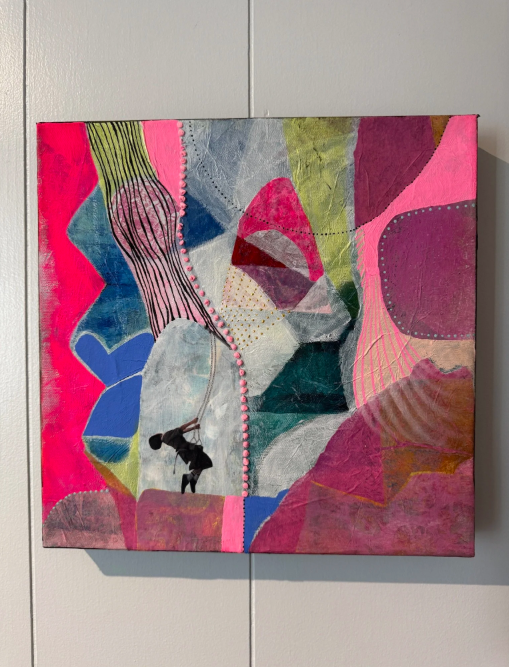
Molly describes her work as mixed media collage, and in some cases assemblage. She’s taken classes in pottery, printmaking, oil painting, acrylic abstraction, and plenty of collage workshops. She’s careful about calling herself “self-taught,” because she’s had so many influential teachers and mentors over the years.
When I asked what defines her work, she talked about:
- Color and shape
- A paper component that invites touch and close looking
- Physical materials in a digital world
- Repurposing discarded items into something new and beautiful
That last point matters to her. She loves the idea of taking what is cast off and giving it a second life.
Themes: women’s issues, current events, power, and the body
Molly’s work is intuitive, and she often doesn’t fully understand what a piece is “about” until she’s well into making it.
She spoke candidly about themes that recur in her work:
- Women’s issues and women’s rights
- Current events
- Colonialism, imperialism, and cultural control
- Power and who gets to hold it
- Personal experience and what the body carries
One series she mentioned began after an emergency room visit tied to a tree nut allergy. The experience brought up anxiety and trauma, and that emotional reality started to surface through the work. She described it as “bodywork,” a response to what’s happening internally, and how the body can feel like it is overreacting.
She also makes room for humor. Sometimes that is the only way through.
The creative process: paper, side quests, and “giving women a new space to exist”
Molly’s creative process is not linear. She described it like a maze, full of side quests.
Sometimes a piece begins with a single material. A piece of paper. A color combination. A shape that clicks into place.
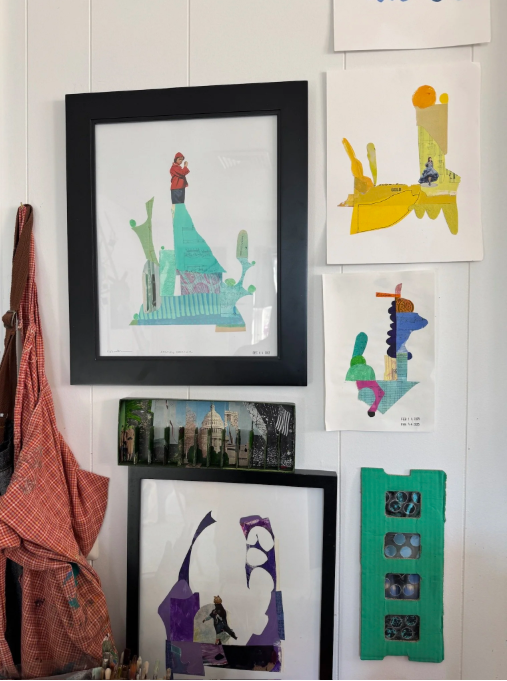
She shared one series that started with her dad’s old National Geographic magazines from the 1950s and 60s. Those older papers have a special feel, and she cut out women from the pages, then re-situated them into new abstract landscapes and interiors.
What I loved about this is the intention. She talked about how many of those photos were taken without meaningful consent, and how the women likely never imagined their image would be published for millions to see. By collaging them into new spaces, Molly reframes their presence. She gives them a different environment. A different agency.
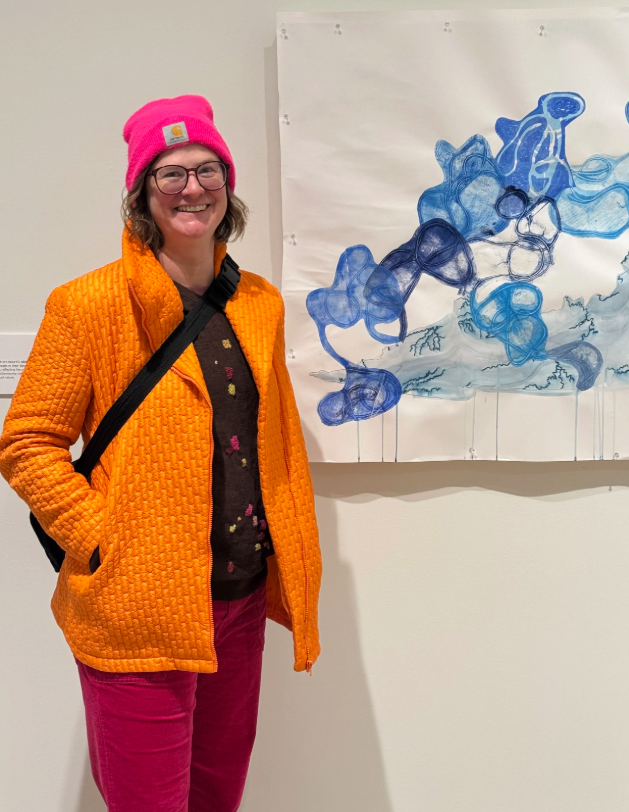
She even uses words pulled directly from collage materials as titles. One piece currently on view at Falls Church Arts is titled “Control Yourself.”
Nature, community, and teaching as fuel
Molly finds inspiration outdoors and often pulls greens and blues into her work. Even when she’s working with neon color palettes that do not appear in nature as often, she still sees her connection to the natural world as a steady influence.
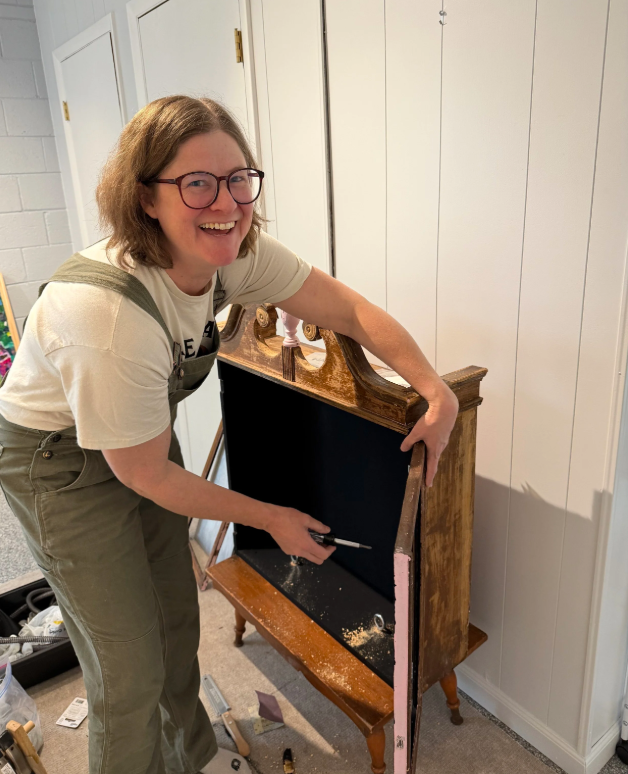
She also sources materials with a scavenger’s eye, repurposing paper rolls, found furniture, and items left out on trash day.
And then there’s community.
Molly spoke about how much she loves being surrounded by other artists, and how museums, galleries, and creative friendships keep her energized.
Teaching is also a major influence on her practice. She runs adult and kids classes, and shared how students constantly spark new directions. Questions lead to research. Research leads to new ideas. Kids, especially, show up fearless and willing to try anything. That bravery feeds her.
What she does when she feels stuck
Molly’s answer here was simple and so useful.
She goes back to basics.
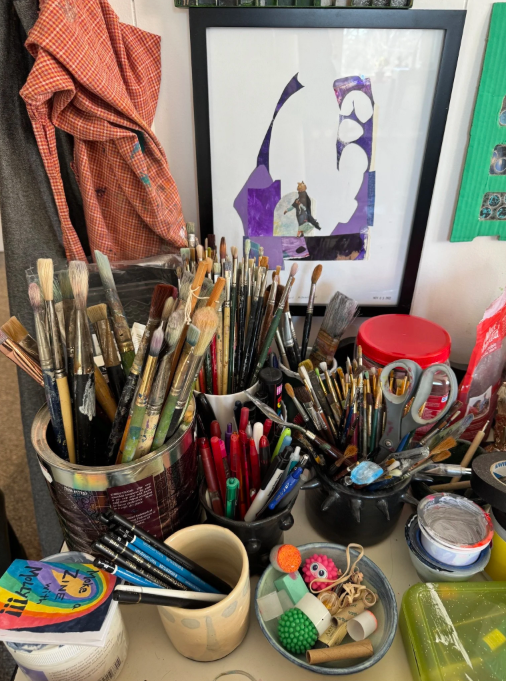
She cuts paper. Paints papers in colors she loves. Cuts circles and plays with them until something catches her eye, a combination, a rhythm, a relationship between shapes.
It is a reminder that “making” does not always have to start with a big concept. Sometimes it starts with your hands.
Consistency vs experimentation: “I don’t care”
This part made me smile.
When I asked how she balances experimentation with maintaining a consistent style, Molly said, essentially, that she doesn’t worry about it. She knows galleries often want consistency, but for her, the point is the work itself. She needs to make. If she does not get it out, it feels bad.
She also acknowledged the privilege of not having to force commercial outcomes, while still feeling genuinely happy when someone wants to live with her work.
Art in the home: color, weird stuff, and access for everyone
When we shifted into how art transforms a space, Molly lit up.
She believes art is essential in a home. It brings color, shape, interest, and visual nourishment. She talked about a school near where she grew up that had the chance to rebuild as something vibrant and beautiful, but instead became a brown box. In her view, color and murals could have changed everything.
Her take is that art should be personal. What’s beautiful to one person might feel weird to another. And she loves “weird stuff.” She collects art from friends and artists she admires, and she likes living with pieces that surprise you.
Most importantly, she believes art should be accessible. Not reserved for the one percent.
She shared her love of the growing movement of Free Little Art Galleries, including one at her studio community, and others throughout the region. It’s a give-and-take model that invites everyone in, including people who might not even consider themselves artists.
It’s a generous way to make creativity part of everyday life.
Advice for emerging artists: practice, rejection, and keep going
Molly’s advice is grounded and empowering.
No artist loves everything they make. Not every attempt is going to land. That is normal.
She compares art to learning an instrument. You do not pick up a violin and immediately play a concerto. You practice. That is why it is called an art practice.
Her encouragement is to keep doing the thing. Join an Instagram prompt challenge like a daily collage month. Make work. Apply to shows. Expect rejection. Keep a folder of it if you need to. Then keep going anyway.
Because if you keep going, things start happening.
What’s next for Molly in 2026
Molly has a full slate ahead, including:
- Participation in LOOK, a group show with the Langston Boulevard Alliance where artists take over an old Walgreens space, with workshops and performing arts programming
- An Artist in Residence role at the Innovation Studio for the Museum of Contemporary Arlington near Met Park
- Work on view at Falls Church Arts through a regional women artists exhibition
- A two-week show with her studio community at Rarebird, a local coffee shop
- Ongoing classes and collaborations, including Friday morning sessions and community-based teaching programs
She described it as “a bunch of stuff and it’s all good,” which feels like the perfect tagline for a working artist in motion.
Closing thoughts
Talking with Molly reminded me that the best art does not just decorate. It holds story, texture, courage, and point of view. It changes the energy of a room because it changes how you feel inside the room.
If you are building a home that feels more you, this is exactly why I encourage clients to collect original work and to meet local artists. Pieces like Molly’s bring a kind of presence that mass-produced decor simply cannot replicate.
If you’d like to incorporate original, locally made artwork into your home in a way that feels intentional and elevated, I’d love to help you curate the right pieces and place them beautifully.
Reach out to schedule a consultation, and let’s talk about the kind of art your home is ready for.